So Much More Than a Game.
Football as a Pathway to Life.
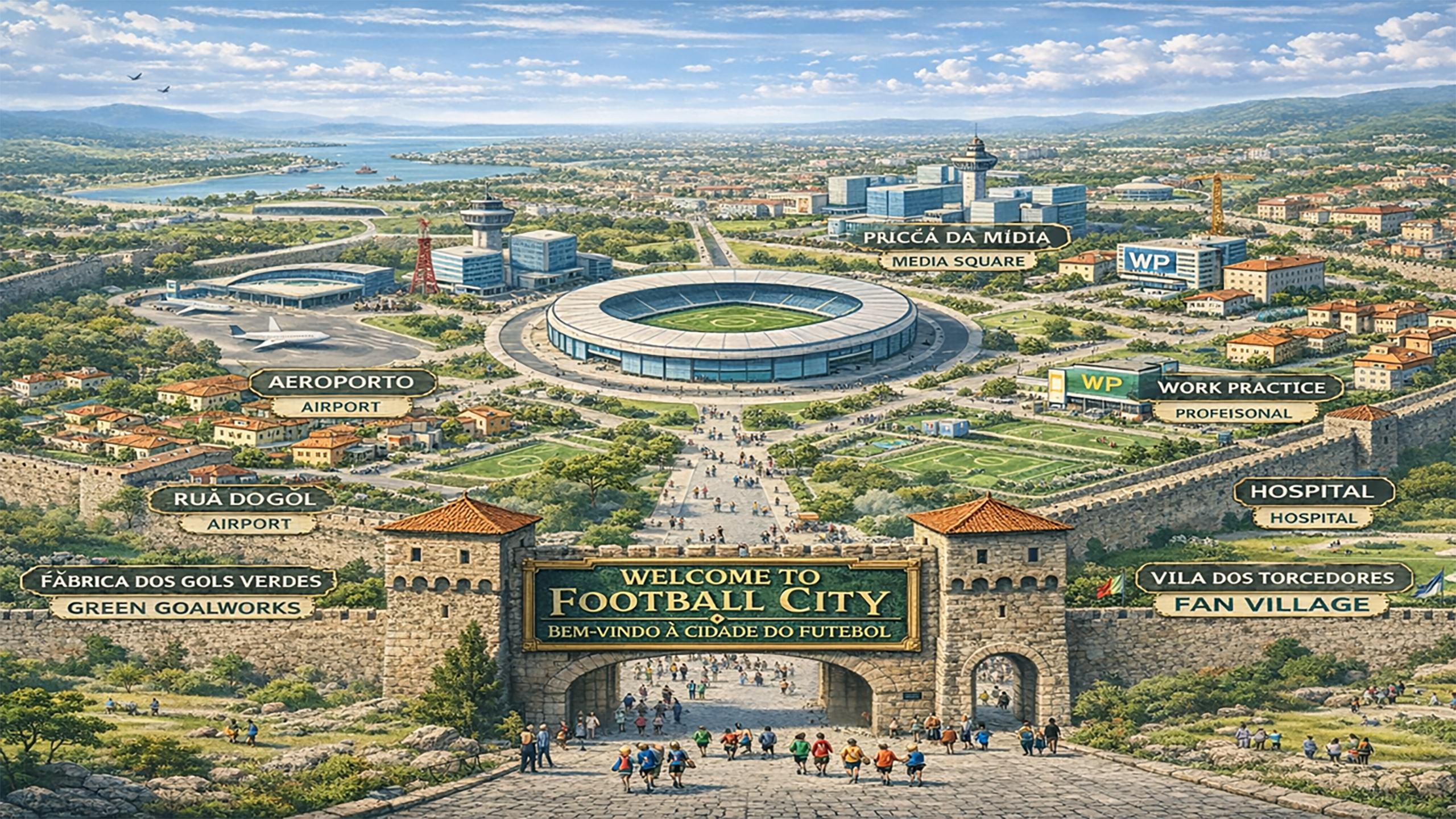
Welcome to Football City!
An interactive, innovative almanac that transforms a passion for football into learning, citizenship, and future career opportunities. Football City connects the universal language of sport with science, technology, engineering, mathematics, communication, and emotional intelligence.
Young Players & Students (Ages 7–17+)
Develop technical and tactical skills, teamwork, and discover exciting careers both on and off the pitch.
Parents & Families
A shared learning tool to encourage studies, strengthen core values, and align dreams with realistic preparation for the future.
Educators & Coaches
A multidisciplinary educational resource (STEM, English, history, and society) designed to engage students through sports.
What is Football City?
A complete educational ecosystem in an interactive almanac format. It transforms a love for the game into focus, curiosity, and intellectual growth.
Readers Choose Their Own Route
Forget dry, linear textbooks. Inspired by the visual flow of subway maps, young readers take control and build their own technical or scientific learning journey every time they open the book.
- The Pro Player's Classic Route
- The Stadium Engineer's Technical Route
- The Media & Podcasts Communication Route
Reading + Action (Almanactivity)
A proprietary active methodology: "read a little, do a little." The content challenges youth to draw, calculate real dimensions, and solve dynamic problems applied straight to the pitch.
- Calculating dimensions and goal net meshing
- Physics analysis of ball trajectories
- Eco-friendly stadium water management projects
Inspiring Stories
The core story follows Zelé, a determined kid whose journey at the Santos Academy reflects the real-world sacrifices and early dedication of King Pelé, teaching the power of academic discipline.
- Managing expectations and building resilience
- The vital importance of an educational Plan B
- Biographical inspiration from legendary icons
The Book Grows with Your Child
A modular pedagogical framework divided into three strategic complexity levels, ensuring years of continuous use.
Kick-Off Phase
8 to 11 years oldIn this initial phase, the almanac works by sparking an early passion for voluntary, enjoyable reading through visual aids and counting activities.
- Motor skill development
- Simple field mathematics exercises
- Introductory concepts of hydration and sleep
Midfield Phase
11 to 14 years oldFull focus on intermediate cognitive development, stimulating tactical thinking, systems logic, and collective social maturity.
- Spatial formations (triangles and diamonds)
- Introduction to sports mechanical physics
- Communication and leadership skills
Premier Phase
15 years old and upAdvanced and realistic analytical preparation for adulthood. Practical guidance for career choices based on the technical ecosystem.
- Sports career and financial management
- Computer-assisted tactical analysis
- High-performance psychology and emotional focus
Metro Map — Football City
Explore the learning lines, stations, and terminals of football knowledge
Line 1 – Red
Fundamentals ➔ Academies- Fundamentals Station Basic football skills and techniques
- Rules & Regulations Station Laws of the game and refereeing
- Tactical Intelligence Station Game reading and teamwork
- Football Academies Terminal Player development
Line 2 – Orange
Legacy ➔ Citizenship- Origins Station The inspiring journey of Zelê and Pelé
- Overcoming Obstacles Station Dreams, challenges, and life paths
- Family & Education Terminal The value of family background and studies in sports
Line 3 – Teal
Aerodynamics ➔ Engineering- Ball Physics Station Magnus effect, curve balls, and trajectories
- Pitch Geometry Station Mathematics of lines, areas, and angles
- Stadium Engineering Terminal Structures, goal nets, and sports architecture
Line 4 – Blue
Geography ➔ World Cup- Global History Station The evolution of sports through the centuries
- Football Geography Station Continents, cultures, and time zones
- FIFA World Cup Terminal The biggest spectacle and its global impact
Line 5 – Purple
Communication ➔ Content- Podcasting Station Digital broadcasts and audio/video production
- Comedy Club Station Humor, sports rhetoric, and public speaking
- Journalism & Media Terminal Content creation and digital coverage
Line 6 – Coral
Sociology ➔ Inclusion- Sports Sociology Station Group behavior and fan base dynamics
- Mentorship & Volunteering Station The power of community engagement
- Inclusion & Citizenship Terminal Social responsibility through football
Line 7 – Turquoise
Operations ➔ Data- Utility Systems Station Compressed air and support equipment
- Energy & Lighting Station Electricity and stadium floodlights
- Water Sustainability Station Water cycle, treatment, and reuse
- Data Management Terminal Control systems and monitoring
Line 8 – Gold
Technology ➔ Management- Artificial Intelligence Station AI, data, and performance technology
- Women's Football Station Women's leadership and expansion in the game
- Sports Economics Terminal Finance, management, and football business
Line 9 – Green
Work Practice (WPU) ➔ Eco-Stadiums- WPU Station Work Practice Unit in football
- New Careers Station Innovative sports market professions
- Green Stadiums Terminal Solar energy and biodegradable materials
Volunteering and the Work Practice Unit
Add subtitle…
Start before the job. Volunteering and work practice can give you genuine examples of responsibility, teamwork, communication and problem-solving.
Absolutely. Turning up on time, helping people, accepting responsibility, organising something or working as part of a team are all experiences you can talk about when applying for work.
That's one reason to explore. Volunteering and the WPU allow you to experience different roles and discover what interests you — and sometimes what doesn't.
Confidence. Independence. Decision-making. Communication. Teamwork. And the experience of discovering that other people can depend on you.
It may be much lower than you think. Your first rung could be helping at a community event, joining a voluntary project or taking responsibility in a work-practice environment. You don't have to wait for your first employer to start building your future.
Frequently Asked Questions
Find answers to key questions about the content, pedagogical value, and practical applications of the almanac.
Absolutely not. While the book provides essential positioning tips and training routines for young athletes, its core pedagogical focus is showcasing the vast industrial and corporate ecosystem surrounding the sport. The goal is to channel a passion for the game into exploring fields like science, data engineering, journalism, sports medicine, and international project management.
The book features an internal learning pathway map. Younger children (ages 7 to 11) start with the "Kick-Off" journey, focusing on visual activities, basic on-field counting, and inspiring stories. As they grow older, they can revisit the same pages to explore deeper, more complex layers (such as ballistics physics and tactical data analysis programming).
No, it has been pedagogically calibrated by second-language acquisition specialists. The texts utilize contextualized immersion (using universal scoreboard terms, FA rules, positions, and tactics). The "Learning English with Zelé" section offers structured bilingual support to ensure smooth, frustration-free progress for the learner.
Yes, the book is designed as a "Hands-On Education" manual. Teachers of Mathematics, Physics, Physical Education, and English will find ideal entry points to create integrated activities, science fairs centered on sustainable stadiums, and tactical debate clubs.